What to Play. Deathmatch Island
Production prides itself on offering an equal deathmatch experience to every single competitor. Racism, sexism, ableism, and other bigotries will not be tolerated. It is important that all competitors can kill and die without discrimination.
I recently played a one-shot of Deathmatch Island by Tim Denee. And I had a blast! It is a great use of the Paragon system in a familiar media genre (if you’ve seen Squid Game or played any battle royale game). The design of the encounters and the points of interest is a big part of why it was enjoyable, and why the overall situation was always easy to grasp.
Registration
The beginning of the game is easy and fast thanks to the many tables for generating your character. For one-shots there are two ways, in my experience, to get a fast start: either have pre-built characters for the players to choose from, or provide several tables to roll a character on (or to pick from). That gets the decisions made in five minutes instead of a potential hour of complex system questions before any scene has even begun.
The game also uses a great character sheet design, so that all the information you need is visible when you need it, and is mostly self-explanatory. Why only mostly? Partially because of the visible [redacted] parts on the sheet. And partly because there is still a lot of information to track at first glance. Followers? Weapons? More equipment? And why is there a repeated “DIE” on the side?
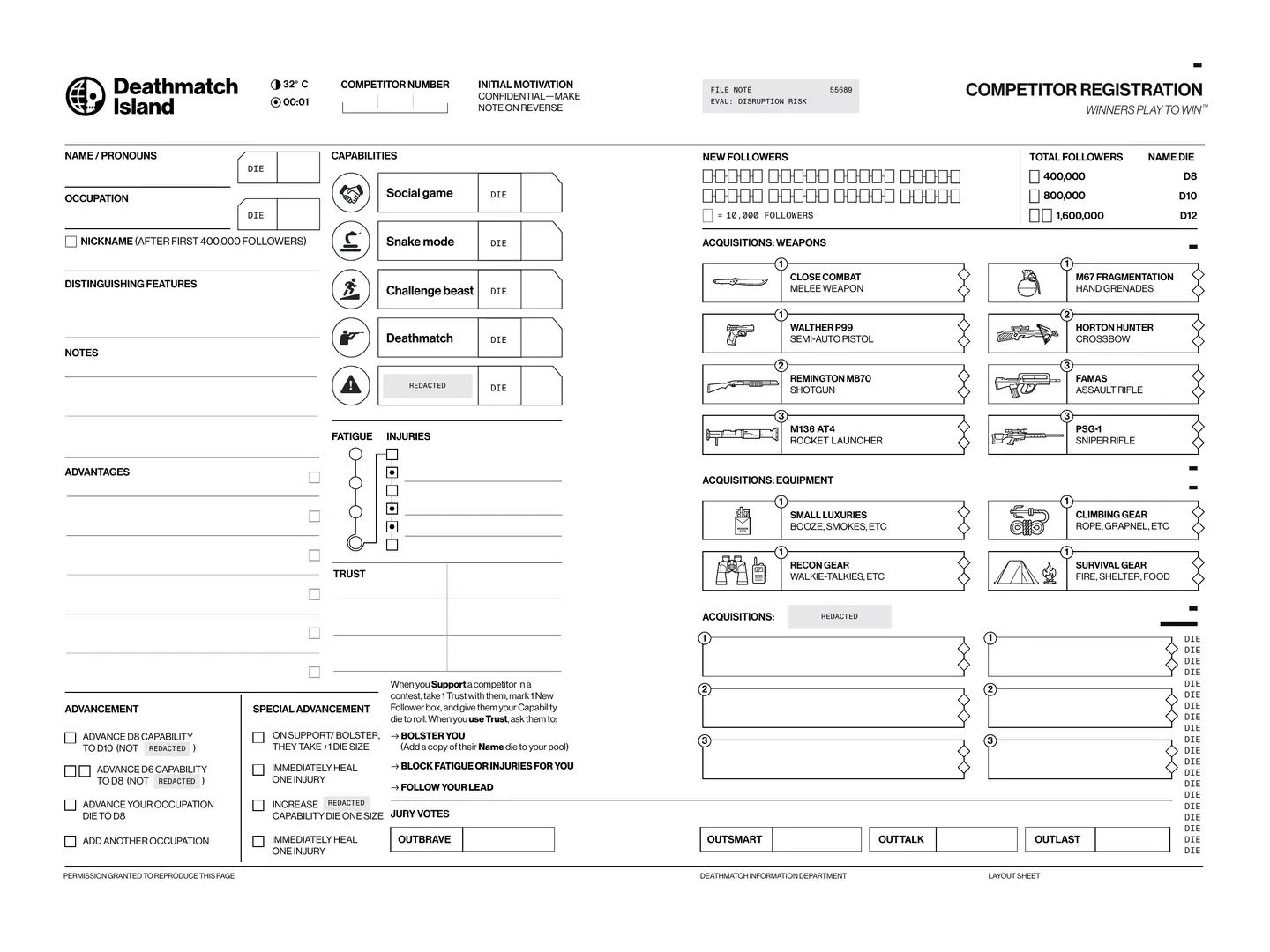
By completing just three rolls you already have a mechanically playable character. Only a few more details, like their name and distinguishing features, and you are good to start. Those are also rollable, if you need them to be. It reminds me of Dark Heresy or Warhammer Fantasy Roleplay, where you can roll a character in five minutes and stick with them for the whole campaign (the modern variants, WFRP 4th edition and Imperium Maledictum, even give you bonuses for doing it).
Scouting
As the game is essentially about violence, safety tools are good practice at the table. And there are good ones built in already. You can also use whichever ones your group prefers1. Be mindful of what you don’t want to see during the game, and of what other players might be uncomfortable with.
During the first scenes, the game incorporates what is essentially a session zero. You go around in rounds, asking rather personal questions about your characters and creating flashback stories about how they ended up on this lethal TV show. This also gives you some of the resources you will need to survive later.
First encounters
The game is fast and extremely deadly for characters. You are greeted with unfair challenges from the start, and you are expected to fail most of them. To give you an example: our first encounter was with a group of armed hooligans essentially hunting helpless people. There were dozens of them, armed with guns. Our characters had only the element of surprise and very little time to save anyone at all from the massacre.
If you are new to more narratively focused games like AGON or Blades in the Dark: any result heavily influences the story. Even failed rolls generate something worth telling. What went wrong? Did you save anyone at all? How did your teammate save you from harm? Those are the questions you keep answering, progressing through the story even on failed rolls. You are also encouraged to follow good improv practices like “Yes, and…” to keep the flow moving. The game is about the story rather than about winning as such (though you are given plenty of motivation to win).
And then there are the followers. As this is a game about a TV show, your characters generate followers with every roll. Won a challenge? Mark a hundred thousand new followers, or more. Failed? Mark a mere ten thousand new followers. The more followers you have, the more powerful your character is in game terms — you could say they are growing plot armour.
Exploring
The gamebook provides several islands the characters can explore during their campaign. And there is enough description to ground a scene and to keep going almost without stopping to think or ask questions. The game also discourages long planning2 and encourages action and in medias res.
In the one-shot, all the locations were condensed into a single island. Exploring different locations provides you with useful items that you will definitely need in later challenges, as they only get harder.
Special note about [redacted] areas. You can play against the hosts (breaking the game), but it is explicitly more challenging — and it may still be part of Production’s plan to make a more entertaining show. Normal equipment is useless in [redacted] areas, which instead provide items that help mostly with [redacted] checks. With this you can always choose to beat the game in a whole other sense. But it won’t be easy.
Competing
During the second part of the game you are expected to compete to survive. Now you are facing squads of better-equipped competitors (or even other players) trying to murder your characters specifically. Nothing personal, just show ratings.
This part of the game is where you are expected to take several wounds by failing challenges, spend at least some of your gear, and maybe strengthen bonds with other characters by helping them survive. And you will need those bonds. First, spending Trust lets a teammate hand you a copy of their Name die3, which gives you more consistency on your rolls. Second, they can block Fatigue or Injuries for you, which will save your neck when a roll goes badly.
In the Paragon system you first gather your dice pool, roll it, and sum the two highest dice, then add any additional dice. Those additional dice are 4-sided, and they come from your Acquisitions: spend a piece of gear and you roll one die per Tier, then add only the highest of them to your total. You can spend resources to roll more dice, but you will always wish you had more. Because rolling a 15 out of two 8-sided dice and a single d4 takes real luck. Sometimes you will pick up an Advantage die, worth anywhere from a d6 to a d10 depending on how well the fictional detail applies. A great addition, if you can roll anything other than a 1 on it. Twice in a row, in my case.
Breaking
The final part of the game is the final battle. Every character chooses in secret whether they try to break or win the game. If you are playing to win, you proceed to player-versus-player scenes where you try to be the last one standing and claim the prize. If everyone unanimously agrees to break the game, your group is challenged to finish off some aspect of the game, or to shut it all down. Of course our group chose to break the game.
Every one of the three challenges in the last part is the hardest you have faced yet. And just attempting each one costs you resources.
Our group was not lucky enough to complete the final challenge, and two out of three characters died trying. One of the characters was an art teacher, and no match for a squad of armed security personnel. Another was ex-military, and broke into the room with the TV host. Only to be shown that every plan to break the game had been Production’s intention all along, then restrained and shot by the gang leader who had mysteriously kept escaping our earlier engagements.
In conclusion
I already said that the game session was great. I played with a GM I know, another player I had played a season of Blades in the Dark with, and one player I had never played with before. The group’s vibe is always what determines whether a game turns out memorable. But I also think the design of the game is a big part of this.
I would recommend you try this game, at least in its one-shot version. Especially if you like Evil Hat’s other games, or John Harper’s. It took us five hours to finish, though that will clearly differ from group to group.
Deathmatch Island gives your group a fast and action-heavy experience. Lots of lethal challenges, character trauma, and drama cues. Enough written setting that you never have to think twice about what is going on, and enough open questions to make you wonder what is behind the curtain. Or what would happen if you tried to break the game.
This post is part of my #100DaysToOffload challenge.
Footnotes
-
We used the Lines and Veils toolkit. It is fast and, in my view, provides enough clarity to create a safer experience during the game. You don’t want to ruin your session with a prolonged ethical conversation or an abrupt ultra-violent scene. ↩
-
Similar to Blades in the Dark, another game by John Harper, one of the designers of AGON and the Paragon system. ↩
-
This is where the follower count matters. Your Name die starts as a 6-sided one, and as you accumulate followers it grows to 8-sided, then 10-sided, and finally 12-sided. ↩